


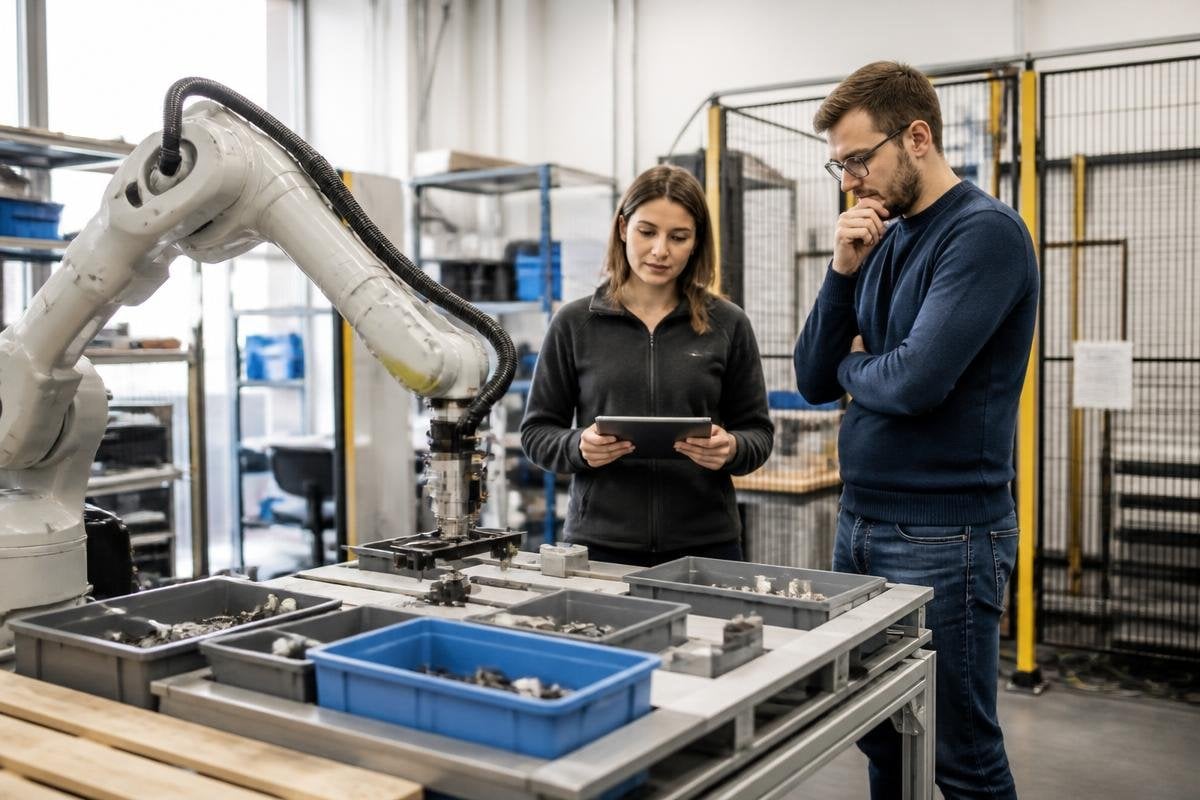
Sorting parts in a lab can work while the same robot fails on a factory floor. The move from research to business starts when a team measures the full job: the robot, its work area, its safety system, and the people who maintain it.
- Lab success: proves a task can work under set conditions
- Business value: connects that task to time, cost, and output
- Buyer confidence: comes from repeatable results and clear limits
The lab test is only the start
Research work often focuses on a hard technical question. Can a robot grip an object, keep its balance, map a room, or plan a path? Those tests matter, but a company buys a working process rather than a single clever action.
The next test adds the conditions that research demos may control tightly. The team checks dust, changing light, uneven floors, blocked paths, object wear, network loss, and recovery after a failed move. Each condition can change how the robot behaves.
One mobile robot may use LiDAR to measure nearby objects and simultaneous localization and mapping, or SLAM, to build a map while it moves. A factory still needs to know how that system reacts when a pallet sits in the wrong place or a person enters the route.
That is why repeat runs matter. A buyer needs records for payload, battery runtime, charging time, cycle time, and failed tasks. One successful run proves possibility. A long run with logged results gives the buyer something to price.
The work must fit the site
Every robot works inside a process, so the site has to supply the conditions that process needs. Floor space, power, network access, lighting, aisle width, loading points, and shift patterns all affect the result.
This can change the design. A robot that carries parts between two fixed stations may need accurate docking more than high speed. A picking system may need a different gripper for each box surface. An inspection robot may need a camera position that stays steady while the vehicle moves.
The software matters too. ROS 2 can connect sensors, control code, and other parts of a robot system, but a company still needs a plan for updates, logs, permissions, and recovery. Someone must decide who can change the code and who responds when the robot stops.
The business case should use the work already done by people. If a robot removes a manual trip, record the trips per shift and the minutes spent on each one.
If it moves goods, measure payload and cycle time beside the current process. The comparison should use the same task and the same site.
A lab result earns business weight only after someone records the task, site, and limits. Robot24.com robotics coverage gives you reported examples to place beside that comparison, before safety and service decide whether the machine can stay in daily use.
Safety and service decide the sale
Safety work begins before the robot reaches production. The team needs a risk review, defined stop behavior, guarded areas where needed, and clear instructions for people near the machine. Industrial robot systems may be assessed against ISO 10218, while the exact requirements depend on the robot, task, and country.
A safety case also needs failure tests. What happens after a sensor fault? Can an operator reach the emergency stop? Does the robot stop when its network connection fails? Does it restart in a known state, or does a technician have to clear the whole system?
Service can decide the purchase just as quickly. Buyers should ask how long a battery swap takes, which parts are stocked, how logs are exported, and who fixes faults outside normal hours. A robot that needs a specialist for every reset may cost more to run than its purchase price suggests.
The strongest opposing view is that early pilots should move fast and solve these details later. I’d reject that plan when the robot works near people or handles paid production, because missing service and safety work can stop the pilot before its results mean anything.
A practical decision guide
Use this checklist before moving from a research demo to a paid site:
- Name the task: write the start point, end point, object, cycle, and human handoff
- Record the limits: list payload, runtime, floor type, lighting, network needs, and temperature
- Run failure tests: block routes, remove a sensor, cut the network, and test recovery
- Price the full system: include installation, training, charging, spare parts, software, and service
- Set the pass mark: choose the output, uptime, and safety result that earns a wider rollout
The pass mark should come from the business process, not the demo video. A company may accept slower movement if the robot runs through a full shift and cuts a task that people find costly or unsafe.
Research will keep producing robots with better hands, legs, sensors, and planning software. The systems that reach paying sites will be the ones that connect those parts to a measured task, a safe work area, and a service plan someone can run after the research team leaves.
